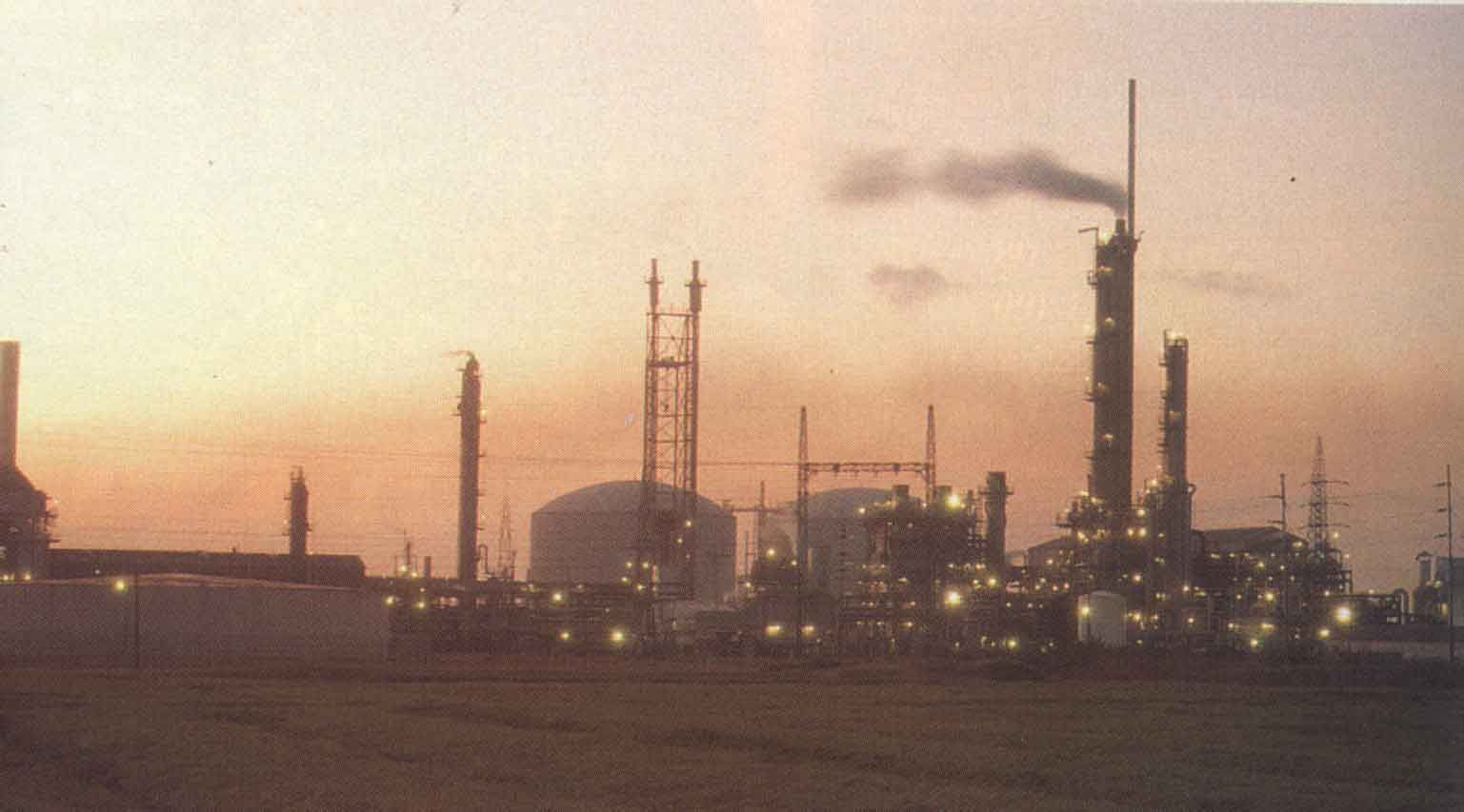


Trinidad and Tobago is rapidly emerging as one of the most sought- after locations for energy-related industrial activity in the western hemisphere. International investors seem to have decided that the presence of substantial reserves of natural gas ( 10 trillion cubic feet of proven reserves at last count), plus a package of other attractions, makes the country an ideal place for buying into existing energy-based industries or establishing new ones from scratch.
Norsk Hydro, Norway’s largest industrial company, began the latter-day trek to Trinidad and Tobago when it decided that W. R. Grace, the US chemical giant, was ill- advised to sell its ammonia manufacturing plants in the country in 1990, and promptly offered to buy them.
It took over Grace’s 246,375 tonne-per-year Federation Chemicals ammonia facility and its 49% interest in the Trinidad N itrogen Company’s two ammonia plants (the rest is owned by the state), with a combined design capacity of 912,500 tonnes per year.
When the government changed hands in December 1991, bringing the People’s National Movement (PNM) back to power under a Prime Minister, Patrick Manning, who was keen to develop the energy sector and to privatise non-essential, state-owned assets, international investor interest in Trinidad and Tobago heightened considerably.
In March 1993, the government sold its 51% stake in the 730,000-tonne Fertilisers of Trinidad and Tobago (Fertrin) ammonia plant and its 100% holding in the 540,000-tonne Trinidad and Tobago Urea Company (TTUC) plant to Arcadian Partners of the United States. Amoco, which owned the other 49% of Fertrin, also sold. Arcadian paid US$175 million for both plants.
By June of that year, the government was announcing another major deal, involving a state-owned, energy-based company and a foreign investor keen to participate in the benefits available from a Trinidad and Tobago location. It agreed to sell 55% of its holding in the 465,000 tonne- per-year Trinidad and Tobago Methanol Company (TTMC) to two major German firms, Ferrostaal and Helm. The two also agreed to provide the bulk of the finance for a second methanol plant, capacity 500,000 tonnes per year, to be built near the first.
In 1994, the pace began to quicken. In January the Caribbean Methanol Company’s 500,000 tonne-per-year plant was formally inaugurated. This was significant on two counts. It was the first energy-based facility in the country to be funded primarily by a local private sector investor: the Colonial Life Insurance Company (Clico) put up 64.9% of the equity portion of the US$200 million investment required. Its foreign partners were Ferrostaal (25.1%) and Methanex of Canada (10%).
It was also the world’s first methanol plant to be financed purely on a project basis, with no government guarantees and loan capital secured solely on the expected income stream from sales. This was a clear vote of confidence from international bankers in Trinidad and Tobago’s record as a profitable location for energy-intensive industries.
In August, the Nucor Corporation of North Carolina started production of iron carbide at its 320,000 tonne-per- year plant, heralding the world’s first commercial production of a raw material that has the capacity to replace scrap iron in steel plants worldwide. Nucor had decided in January 1993 to come to Trinidad because it had been offered the 15 million cubic feet per day of natural gas that it needed to run a plant at a very favourable price, with free-zone status thrown in as a bonus.
Later the same month, Arcadian announced it would be installing yet another ammonia plant in Trinidad, to produce an additional 25 5,000 tonnes per year, taking its total annual ammonia capacity in the country to 1,055,000 tonnes, including enhancements to the original Fertrin plant.
In September, Farmland Industries of Kansas, the largest farmer-owned agricultural co-operative in the United States, and Mississippi Chemical Company said they would add still further to the country’s ammonia capacity by investing in an entirely new 665,000-tonne project, the largest ever built.
And in early November, three of the world’s major energy companies, British Gas, Amoco and Cabot of Boston, awarded the first five contracts for what is to be the most expensive industrial project ever undertaken in the Caribbean, and the biggest single user of natural gas to date — a US$I billion, 425-million-cubic- feet-per-day liquefied natural gas (LNG) plant. The contracts related to front-end engineering design for the plant and marine terminal, liquefaction process design, on-shore geotechnical site investigation, marine soil boring and initial site preparation. This made it virtually certain that the massive project will get the formal go-ahead in the third quarter of 1995, as planned.
Meanwhile, C and F lndustries (CFI), another large US farmers’ co-operative, is examining the possibility of investing in even more ammonia production in Trinidad and Tobago, and Arcadian is seriously considering further expansion in the same field. TTMC is investigating whether to build a third plant after its present expansion is completed in fourth quarter of 1996. Nucor, for its part, is talking about three more iron carbide modules in Trinidad and Tobago, and Cleveland Cliffs, another US steelmaker, is anxious to join Nucor in the iron carbide manufacturing business.
The interest by foreign companies in the energy field mounts at a dizzying pace. It is hard to believe now that all the energy-based plants following the original investment in ammonia by W.R. Grace in the late 1950s had to be initiated and mainly financed by the government, because foreign investors were reluctant to do so.
This applied to the Iron and Steel Company of Trinidad and Tobago plant, the first TTMC plant, the urea plant and the government’s 51% interest in Tringen and Fertrin. (Iscott was leased to the Ispat steelmaking group from India in 1989, after the government decided it could no longer remain a public sector responsibility. Ispat has now bought the company outright for US$70.5 million. Energy from natural gas is vital to the plant’s successful operation — it uses about 35 million cubic feet per day)
A key element in the package of attractions drawing energy investors to Trinidad and Tobago is the infrastructure they find in the main industrial estate at Point Lisas, where almost all the plants so far mentioned are located.
The Point Lisas Industrial Port Development Corporation (Plipdeco) painstakingly developed the 800-hectare industrial estate and port on Trinidad’s west coast over the last 17 years. It offers all the services the investor requires — electricity, water, fibre optic telecommunications, free zone privileges, bonded warehouse facilities, good roads, and, most of all, an efficient port that can handle the specialised cargoes of ammonia, methanol, urea, iron ore and iron carbide, as well as the containerised and breakbulk cargo needed by tenants on the estate and customers in the wider community.
Plipdeco’s success in cargo handling has been such that Point Lisas not only gives the main port in Port of Spain severe competition, but it now has the potential to develop into a major cargo transshipment point and consolidation centre on the shipping routes between North and South America.
“The fact is, we have everything down here the investor needs,” says Neil Rollingson, Plipdeco’s chief executive officer. “Besides the estate itself and the port, we have all the human resources for energy-based plants plus the key ingredient — a reliable gas supply.”
That gas supply is itself the result of early government planning to ensure that the main ingredient for the creation of an energy-intensive industrial complex could be brought successfully from offshore gas platforms across country to the Point Lisas site on the west coast. To do this, the government-owned National Gas Company laid down a pipeline capable of handling one billion cubic feet of gas a day.
The Point Lisas environment also includes a wide range of downstream industries, industrial suppliers and exporters. These include highly experienced operators like Industrial Gases and Caribbean Steel Mills.
It is no surprise that all the investors in the energy-based industries who come to Trinidad and Tobago want to locate their plants at Point Lisas. But the government is now gently trying to steer them to a new area further down the west coast at La Brea, which it wants to develop into a second Point Lisas.
Both the LNG plant and the Farmland Industries ammonia plant are earmarked for La Brea, which is to be a 1,500- acre facility near Trinidad and Tobago’s first internationally- known landmark — the Pitch Lake. The area already has a good natural harbour and is to be provided with its own gas pipeline and all the necessary public utilities. The National Gas Company has been given the task of developing the new estate and attracting as many industrial clients as possible. The future looks good: Trinidad and Tobago’s current popularity with international investors in the energy sector already owes much to the Company’s persuasiveness and marketing skills.
The Sound of Steel
One of the first industries to be developed at Point Lisas was the Iron and Steel Company of Trinidad and Tobago (ISCOTT), a state-of-the-art plant designed by Midrex Corporation of the US. During its early years of operation, ISCOTT become saddled with myriad problems which reduced output to about 40% of capacity and made it a drain on the treasury and a burden on the taxpayer.
But in 1989, the government took a decision to lease the plant to the India-based Ispat Group of Companies. At the time, the name Ispat was virtually unknown in the region. But five years later, Ispat’s western expansion programme has made the Caribbean part of the global steel industry.
India and Trinidad and Tobago have always had strong cultural ties (over 40% of the population of Trinidad is of Indian descent). Ispat’s westward expansion programme, driven by the Group’s Vice-Chairman, 42-year-old Lakshmi N. Mittal, set out to make the Group a major player in the global steel industry. From Trinidad, Caribbean ISPAT Limited (CIL) has been able to penetrate markets in Latin America, the Middle and Far East, Europe and the Caribbean. An employee motivation scheme produced a dramatic reversal in productivity; today the plant operates at 110% of capacity.
In the last quarter of 1994 Ispat exercised its right to purchase the plant after the first five years of the lease. This means that within the near future approximately US$75 million will be invested in the further development of the plant and its environs. The company has allocated US$20 million to the improvement of environmental pollution control systems and to associated infrastructure such as roads and drainage, while US$50 million will be funnelled into plant upgrades.
This will bring operations into line with international standards both in terms of technology and environment pollution control. Production capacity will increase to 1.2 million tonnes of Direct Reduced Iron (DRI), 1 million tonnes of billets and100,000 tonnes of wire rods. Within the next three years, Ispat will divest 40%of its shares to Trinidad and Tobago nationals, offering special arrangements to encourage employee share ownership.
Inspired by the successful turnaround of the plant in Trinidad and Tobago and motivated by the possibilities for south-south relations, Mittal has now focused his attention on Mexico. In 1991 the Ispat group acquired the largest of the state-owned companies there, and achieved a remarkable turnaround in the first year of operations. In 1994, ISPAT positioned itself to benefit from the North American Free Trade Agreement by acquiring Sidbec Dosco of Montreal, the fourth largest plant in Canada.
With plants in India, Indonesia, Canada, Mexico and Trinidad and Tobago, Ispat is now the largest producer of sponge iron in the world. It has put Caribbean steelmaking on the world map; in Trinidad and Tobago, steel is now the second largest earner of foreign exchange.
Lisa Wickham-Branche